

AI agents have come a long way in both capability and everyday use since generative AI went mainstream in late 2022. In Stack Overflow’s 2025 Developer Survey, 84% of developers said they use or plan to use AI tools in their workflow, up from 76% a year earlier. As those tools shift from suggesting code to writing files and running commands on their own, one practical question follows. How much should an agent be allowed to do without stopping to ask? Turn that dial all the way up and you reach what developers call YOLO mode.
It’s worth understanding YOLO mode before you enable it, because its main risk is easy to misread. The risk comes down to where an agent runs. On your own machine, one mistaken command can delete files, expose your credentials, and make network requests you may not want. Inside a proper boundary, however, developers can use agents in YOLO mode to unlock a new level of productivity, without jeopardizing security.
キーテイクアウト
- YOLO mode is when an AI agent auto-approves every action, with no confirmation prompts.
- It’s popular because it’s fast, and risky for the same reason. The danger isn’t the autonomy, it’s where the autonomy runs.
- On your host, a bad command or prompt injection reaches real files and credentials. Inside an isolated sandbox, the blast radius is contained.
- Run YOLO mode where it can’t do real damage, in an isolated, disposable environment with scoped access and no real secrets.
What is YOLO mode?
YOLO mode is the community nickname for running an AI agent with every action auto-approved. When turned on, agents can read files, write code, run shell commands, and call tools without stopping for user approval. While in Claude Code it’s the –dangerously-skip-permissions flag, other common agents each have their own version of the same switch.
- Codex CLI has `–full-auto`, plus `–dangerously-bypass-approvals-and-sandbox` when you drop the sandbox too.
- Gemini CLI uses `–yolo`, or the Ctrl+Y toggle mid-session.
- GitHub Copilot CLI has `–allow-all`, also aliased as `–yolo`.
- Cursor exposes it as auto-run in settings rather than a flag.
The names differ, but the behavior is the same: remove the prompts and let the agent go.
YOLO mode showed up in Cursor first, then Claude Code, and by 2026 it’s a standard toggle in most coding agents. But when people ask what YOLO mode is, they’re usually asking whether they should use it, and the answer is that it depends entirely on where the agent is running.
Why developers turn it on
On a regular task, a careful agent asks for permission constantly. “Can I edit this file, run this test, install this package, call this tool?”
Dozens of prompts for one feature. While these constant permission requests can help prevent agents from going rogue, each approval forces you to context switch and breaks the flow that made the agent worth using. A few reasons why developers are leveraging YOLO mode include:
- Context switching: Every approval pulls a developer out of their flow, taxing mental focus and overall productivity.
- Prompt fatigue: Excessive querying, refinement, and approvals force creative coding to take a back seat to tedious prompt wrangling and debugging.
- Low-risk, routine work: Agents can often handle repetitive tasks that would otherwise take developers away from creative coding and innovation.
- Momentum: An agent is most useful when it has the freedom to keep moving, but a steady stream of prompts breaks that.
If you turn approvals off, these friction points disappear for the most part, and the agent can deliver the speed it promised. But what’s the cost of giving agents the autonomy of YOLO mode?
Why is YOLO mode risky?
When you remove the prompts, you remove the last human check before an action runs, which amplifies the security risks agents already carry. If the agent is working directly on your host, that action has the full run of your machine, including your files, environment variables, credentials, and network. A confused or compromised agent can do a significant amount of damage when nothing stands between an agent’s decision and your system.
On an unprotected host, YOLO mode introduces risks such as:
- Destructive commands: A vague or mistaken instruction runs something like rm -rf against the wrong directory, and nothing pauses to catch it.
- Secret and credential exposure: The agent can read environment variables, .ssh keys, tokens, and .env files, then use or leak them.
- Prompt injection: The agent acts on whatever it reads, so a hidden instruction in a web page, an issue, a code comment, or a document can redirect it, and the attacker never needs access to your machine.
- Data exfiltration: A mistaken or hijacked agent sends sensitive data out over the network.
- Unintended broad changes: Edits and config changes reach past the task at hand into your other projects.
- Network and lateral reach: The agent can hit internal endpoints and outside services, or act with your credentials to push code and call APIs.
And unfortunately, keeping manual approvals on doesn’t remove all risk. Once permission fatigue kicks in, it can be all too easy to accidentally approve the wrong request. So the safeguard belongs in the environment the agent runs in, where a bad command or a tired click has a greatly reduced scope of impact.
The fix isn’t fewer permissions, it’s a boundary
If prompts aren’t the answer, what is? A boundary the agent can’t cross. Guardrails only work when something outside the agent enforces them. The agent needs a bounding box, with constraints set before it runs and clear limits on what it can touch. Inside that box, it should be free to move as fast as it wants. The goal is to shape the environment so that a mistake can’t damage your systems or leak your secrets.
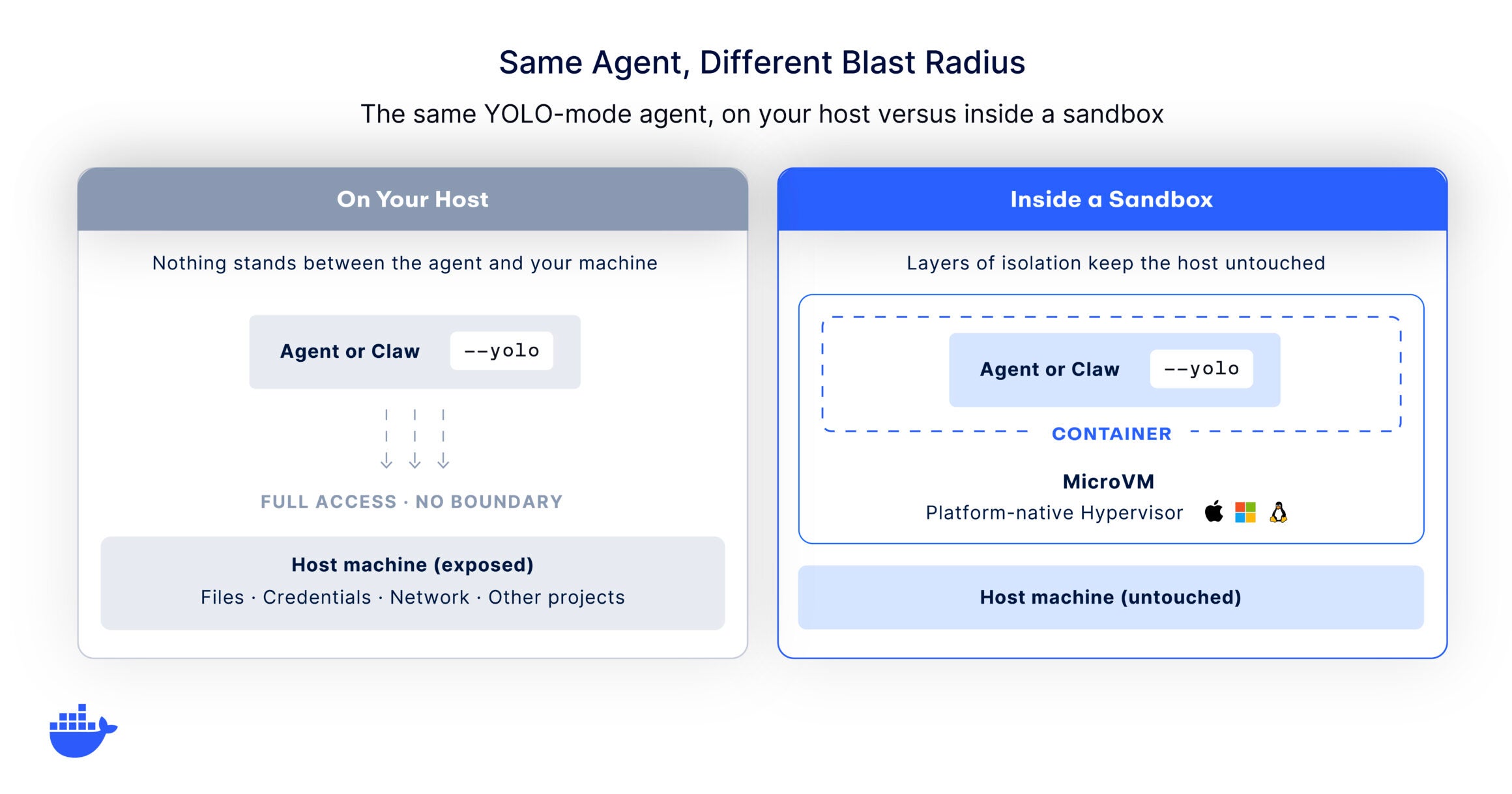
In practice, that means running the agent in an isolated, ephemeral environment instead of on your host. Done well, the agent gets a real place to work. It can install packages, run services, and edit files, but it can’t see your credentials, reach your other projects, or touch the host.
Unlike a container that shares the host kernel, a microVM puts a hardware-level boundary around the agent, so the isolation holds even if the agent tries to break out, and it does that without the speed penalty people expect. If a run goes sideways, you destroy the environment and start clean. This is the core idea behind sandbox security and why agents need isolation in the first place.
What does YOLO mode look like at scale?
For one developer on a sandboxed laptop, YOLO mode is a personal choice. Across a team, it becomes a policy question. A hundred developers each deciding on their own when to skip permissions is the ungoverned-autonomy problem that keeps security leaders up at night. The picture that works at scale is one where the safe path is the default. Every agent runs inside an isolated, disposable environment, configured once at the organization level so it holds for everyone.
This is the problem AI Governance is built to solve. You define the rules once across the surfaces that matter, network access, the filesystem, and the tools an agent can reach, then enforce them automatically at every developer’s machine. Governance turns a per-developer judgment call into a consistent, repeatable capability. Clear boundaries are what let an organization extend autonomy to its agents while keeping the risk contained. Once the boundary is standard, YOLO mode is fast and safe for everyone.
What it unlocks for developers
Once the boundary is in place, the developer can stop supervising every step, and the payoff kicks in:
- Deep focus: Give direction, step away, and come back to a cloned repo, passing tests, and an open pull request. No interruptions pulling you off your own work.
- Long, autonomous runs: The agent edits, runs the tests, reads the failures, and retries until the task is done, the kind of run a wall of prompts would stall.
- Agents in parallel: Point several at different tasks, each in its own disposable environment, and let them run at once.
- You review the outcome: Your job moves up to the pull request, the tests, and the diff, where your judgment matters most.
That’s the real appeal, and the sandbox is what makes it safe to lean on.
エージェントの自律性を安全に解き放つ
YOLO mode is really a question in disguise. How much autonomy can you give an agent before the risk outweighs the speed? Framed that way, the answer stops being about the agent and starts being about its environment. Give an agent the run of your laptop and even a small mistake is expensive. But give it a boundary it can’t cross and you get the speed with almost none of the exposure.
That’s exactly what Docker Sandboxes is built for. Each agent runs in its own disposable microVM with control over networking, filesystem access, and resource limits, so you can run agents in YOLO mode safely from day one. For teams that want those boundaries applied consistently rather than agent by agent, Docker AI Governance sets and enforces the rules everywhere developers work. Define the box. Then let the agent go as fast as it likes.
Get started with Docker Sandboxes →
Explore Docker AI Governance →
よくある質問
Is YOLO mode safe?
It depends entirely on where the agent runs. On your host machine, YOLO mode is risky, because a mistake or a prompt injection can reach your files and credentials. Inside an isolated, disposable environment with scoped access and no real secrets, the blast radius is contained and YOLO mode is reasonable to use.
What does –dangerously-skip-permissions do in Claude Code?
It turns off the confirmation prompts, so Claude Code reads, writes, runs commands, and calls tools without asking for approval at each step. It trades the safety of human review for speed. It’s the most common way people run Claude Code in YOLO mode.
How do I use YOLO mode safely?
Run the agent inside an isolated sandbox rather than on your main machine, give it scoped network access and throwaway credentials instead of your real ones, work against a cloned or disposable copy of your project, and keep a way to inspect what it did. The goal is a boundary the agent can’t cross, not a more careful set of prompts.
Is auto mode the same as YOLO mode?
Not exactly. Full YOLO mode approves everything. Some tools now offer a classifier-gated auto mode that runs safe actions automatically while still blocking or flagging dangerous ones. That’s a useful middle ground, but it’s a filter on top of the agent, not a boundary around it. Isolation still matters.