Stay in the know
Stay up to date on the latest Docker news, opinions and tools.



Welcome to the January edition of Docker Navigator. Missed an issue? Read past issues in our collection.
Docker Hardened Images (DHI) are now free for all developers. In this edition, we break down what that means in practice, how DHI have been independently validated by SRLabs, and why they form the foundation of Docker’s expanding hardened stack. We also reflect on the year agents moved from concept to real-world use, share updates across Docker’s AI and agent ecosystem, and explore the infrastructure shaping modern AI development, from MCP to cloud-native visualization.

Docker Hardened Images Now Free for Every Developer
A new default for container security is here. Docker Hardened Images (DHI) are now free to use and build on, raising the security baseline with trusted, curated images and anchoring an expanding hardened foundation designed to reduce supply chain risk without licensing friction. Start using DHI in your workflows with the step-by-step getting started guide. You may also catch up on a recent DHI launch webinar from the Docker product team.
Docker Hardened Images: Security Independently Validated by SRLabs
Building on the announcement that Docker Hardened Images are now free, independent testing from SRLabs, a leading security research firm, confirms they meet secure-by-default expectations. The assessment shows that DHI delivers measurable security benefits and provides a foundation teams can adopt with confidence.
2025 Recap: The Year Agents Became Real
Software development changed shape in 2025 as agents moved from experimentation into production workflows. This recap looks at how teams are rethinking productivity, system design, and the role of containers in an agent-driven world.
Docker News
Docker Joins the Agentic AI Foundation
Docker has joined the Agentic AI Foundation as a Gold member to help steward open, neutral governance for agent protocols like MCP, Goose, and AGENTS.md. As agents move from prototypes to production, the foundation provides shared standards developers can trust to build interoperable, real-world agent workflows.
Building AI Agents Shouldn’t Be Hard. According to TheCUBE Research, Docker Makes it Easy
New research from theCUBE shows how Docker simplifies AI agent development by reducing setup complexity and standardizing the stack. Teams can move faster from experimentation to production with familiar, repeatable workflows.
Docker, JetBrains, and Zed: Building a Common Language for Agents and IDEs
Docker, JetBrains, and Zed are collaborating on the Agent Client Protocol, a shared standard that lets AI agents work directly inside IDEs and editors. The goal is to enable consistent, cross-tool agent workflows without custom integrations.
Docker Model Runner Expands Across Desktops and Models
Docker Model Runner now ships with Universal Blue desktops like Bluefin and Aurora, providing a simple way to run AI models locally with broad GPU support. It now supports vLLM 0.12 and new open-weights models like Ministral 3 and DeepSeek-V3.2, making it easier to try the latest models without complex setup.
Dive Deep: The Infrastructure Behind Modern AI Development
Explore how teams are moving AI agents from prototype to production using open standards, securing agent workflows, avoiding AI vendor lock-in, and building real-world AI applications, all while visualizing cloud-native infrastructure as systems scale.
Build and Secure AI Agents with Docker MCP
- Learn how to connect MCP servers to ChatGPT using the Docker MCP Toolkit, with a real-world demo showing it in action.
- Private MCP catalogs delivered as OCI artifacts support trusted discovery, versioned toolchains, and GitOps-friendly, sandboxed agents for enterprise AI.
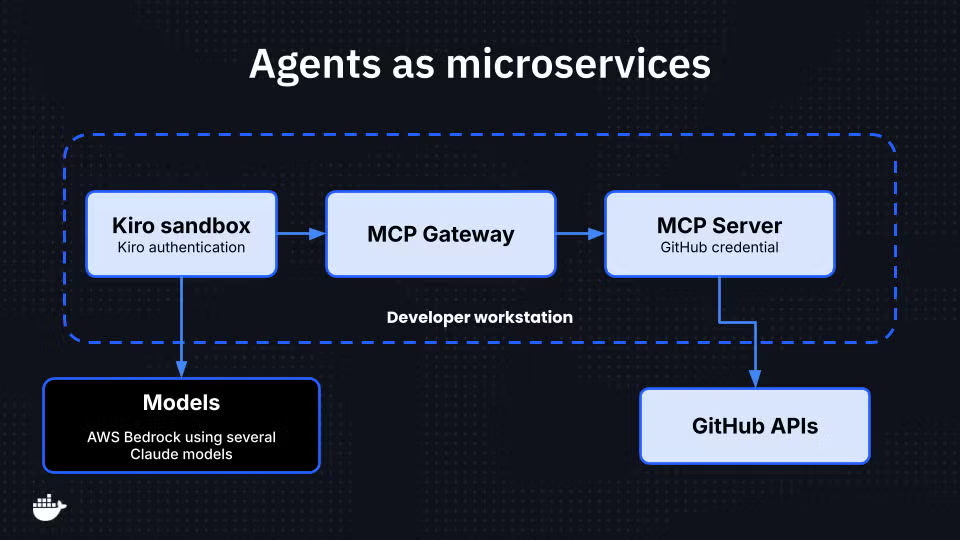
- See how Docker Sandboxes work with the MCP Toolkit + MCP Catalog to isolate local AI agents like Kiro by protecting host credentials and the filesystem, so you can code and ship safely.
Break Free From AI Vendor Lock-in with GitHub Models and Docker cagent
See how Docker cagent integrates with GitHub Models to build and ship multi-agent apps without vendor lock-in.
Unlocking Semantic Search with Docker Model Runner
A practical look at using embedding models for semantic search and running them locally with Docker Model Runner.
From Compose to Kubernetes: Visualizing Cloud-Native Infrastructure with Kanvas
Turn Compose files into Kubernetes and multi-cloud designs you can deploy and operate in Docker Desktop. Visualize, test, and debug everything in a single UI.
Watch: AI Guide to the Galaxy
In the latest episode of Docker’s AI Guide to the Galaxy, Oleg Šelajev is joined by Unsloth CEO Daniel Han, who reveals how Unsloth delivers 2–3x faster fine-tuning, smarter reinforcement learning, and ultra-efficient local AI models. Learn how their dynamic quantization, mathematical optimizations, and behind-the-scenes model fixes are reshaping the open-source ecosystem.
Around the Community
Connect with the Docker community to learn, ask questions, and stay up to date with what’s new in containerization. Explore the Docker Forum for active discussions and our Events page for what’s happening next. Here’s a recent thread from the forum:
- The community collaborated to figure out an issue related to switching to Windows containers, including interpreting logs and giving instructions to roll back configuration that led to the crashing of Docker Desktop. Key learnings were that Windows containers depend on the privileged helper service, and the Windows edition matters.
On the Calendar
Explore Docker’s on-demand webinars from Product and Engineering teams, with highlights including:
- Docker Hardened Images launch (New)
A walkthrough of Docker Hardened Images, now free for every developer, including how to adopt DHI and strengthen your software supply chain in practice. - Building the Supply Chain for the Future
A developer-focused series on building and securing the modern software supply chain with Docker.
That’s a Wrap
Thank you for reading Docker Navigator! If you enjoyed this issue, please share it with your friends so they can subscribe now.
Got any feedback or suggestions for our next issue? Send comments to newsletter@docker.com.